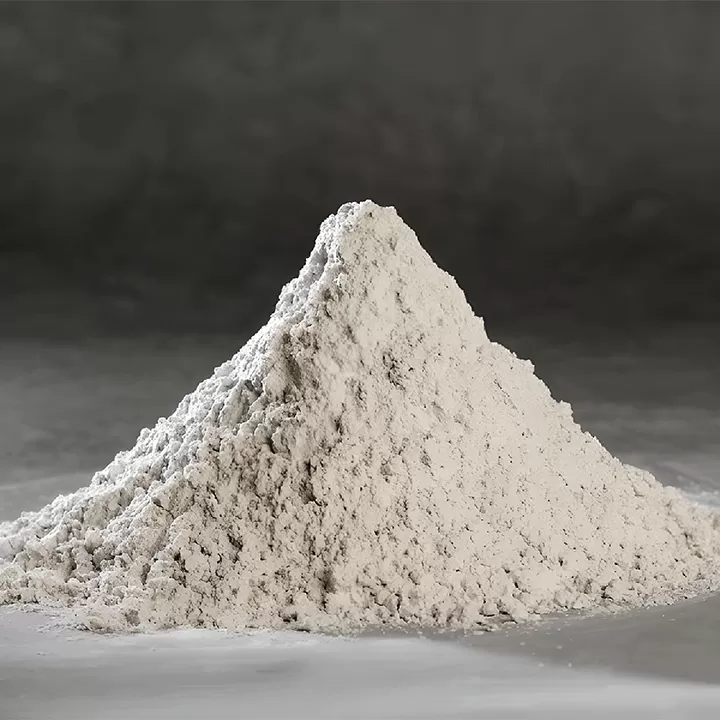
Golden Fortune has supplied high-grade cementitious materials to the global precast and dry-mix sectors for over 18 years. This technical reference examines white powder cement from a material science perspective – covering fineness modules, colour consistency protocols, and solutions to common site failures. Engineers, specifiers, and ready-mix producers will gain actionable data for specifying white cement in architectural concrete, terrazzo, and coloured mortars.
1. Definition and Distinction: What Makes White Powder Cement Different?
Unlike ordinary grey Portland cement, white powder cement is produced from raw materials with extremely low iron (Fe₂O₃ ≤ 0.35%) and manganese content. The manufacturing process includes controlled cooling of white clinker in water or air to prevent reoxidation. The resulting powder has a typical whiteness index (Ry) of 86–92% according to ISO 2470-1. For the end user, this high base whiteness allows true colour development when pigments are added, and it provides a clean aesthetic for exposed aggregate finishes.
Key Specifications of Professional White Powder Cement
Fineness (Blaine): 400 – 550 m²/kg (finer than grey cement for faster colour dispersion).
Residue on 45µm sieve: ≤ 10% for smooth surface finish.
Compressive strength (28d): 52.5 – 62.5 MPa (CEM I 52.5 R grade).
Setting time (initial): 90 – 180 minutes (adjustable with retarding admixtures for hot climates).
Bulk density (loose): 1,100 – 1,200 kg/m³.
2. Manufacturing Purity and Its Influence on Performance
The chemical composition of premium white powder cement is tightly controlled. Below are typical oxide limits and their engineering consequences:
Fe₂O₃ < 0.35% – Prevents brown or greenish cast; essential for pastel shades.
MgO < 2.0% – Avoids delayed expansion due to brucite formation.
SO₃ 2.0 – 2.8% – Optimises setting without false set.
Na₂Oₑq < 0.6% – Reduces efflorescence (white salt deposits on coloured surfaces).
Cl⁻ < 0.04% – Prevents reinforcement corrosion in thin-section precast.
Professional buyers should request an XRF analysis certificate for each shipment. A deviation in Fe₂O₃ by just 0.1% can change the perceived colour of a light-red concrete panel by ΔE > 2.0, which is visually noticeable.
3. Particle Size Distribution and Its Role in Surface Finish
For architectural precast and self-levelling screeds, the fineness and particle shape of white powder cement directly affect water demand, pigment dispersion, and final surface gloss. Using laser granulometry, three key fractions are identified:
D10 (≤ 3 µm): Influences early hydration and initial colour development – higher fines give faster colour uniformity.
D50 (12 – 18 µm): Standard mean diameter for good workability and strength balance.
D90 (≤ 45 µm): Oversize particles cause surface pitting and uneven pigment absorption.
Manufacturers producing polished terrazzo or exposed aggregate panels often specify a white powder cement with D90 ≤ 30 µm, achieved by additional air classification. This extra step increases cost by 8–12% but eliminates pinholes after grinding.
4. Whiteness Measurement Protocols and Batch Consistency
Colour control is the number one requirement for white cement buyers. The industry standard is ISO 2470-1 (diffuse blue reflectance factor). Premium grades maintain Ry > 88%. For coloured cements, the base whiteness must be known to calculate final colour after pigment addition. White powder cement suppliers should provide a spectrophotometer report with L*a*b* values. Acceptable batch-to-batch tolerance: ΔE ≤ 1.0 for white cement alone; ΔE ≤ 1.5 for pre-blended coloured cement.
Common causes of whiteness drift:
Fluctuation in kiln fuel ash (heavy fuel oil vs natural gas).
Variation in limestone purity (MgCO₃ content).
Contamination from grey cement during mill cleaning.
To avoid site rejection, buyers should enforce a clause: "Each delivery shall be accompanied by a whiteness test certificate; if measured Ry deviates by more than 2 points from the approved sample, the consignment is subject to rejection."
5. Application-Specific Requirements for White Powder Cement
Different construction segments demand tailored properties from white cement. Below are the most demanding applications and their technical parameters.
5.1 Dry-Mix Tile Adhesives and Grouts (C2TE Grade)
White powder cement used in flexible adhesives must have controlled aluminate (C₃A) content between 4–6% to avoid rapid reaction with calcium formate accelerators. Additionally, the cement must be compatible with redispersible polymer powders (RDP) without causing flocculation. A high-whiteness cement (Ry ≥ 88%) allows light-coloured grouts to be produced with 30% less pigment, lowering formulation cost.
5.2 Architectural Precast Concrete Panels
For facade elements, the cement matrix must achieve low permeability (chloride migration coefficient ≤ 2×10⁻¹² m²/s) to prevent carbonation-induced fading. Blending white cement with ultrafine Golden Fortune GGBFS (700 m²/kg) at 15% replacement improves freeze-thaw resistance while maintaining a light grey-white colour – suitable for bush-hammered finishes.
5.3 Terrazzo and Polished Flooring
Terrazzo contractors require a white powder cement with low bleeding (≤ 1.5% water separation) and high early strength (≥ 35 MPa at 7 days) to withstand grinding machinery. The cement should have a controlled setting time of 100–130 minutes initial set to allow marble chip placement without cold joints.
5.4 Glass Fibre Reinforced Concrete (GRC)
For lightweight GRC panels, the pH of the cement paste must be below 12.5 to prevent alkali attack on AR-glass fibres. Replacing 10% of white cement with metakaolin (white calcined clay) reduces pH to 12.0–12.2 while maintaining whiteness. Pre-blended white GRC cement is now available with integrated acrylic polymer.
6. Handling, Storage and Shelf-Life Challenges
Unlike grey cement, white powder cement is more sensitive to moisture because any pre-hydration forms dark grey spots. Key storage rules:
Store in sealed silos with silica gel breathers or laminated paper bags with polyethylene inner liner.
Maximum relative humidity in warehouse: ≤ 60%.
Shelf life: 6 months from production date for guaranteed whiteness; after 8 months, test for lump formation and colour shift.
Do not use compressed air with oil content to convey white cement – oil mist causes yellow staining.
For bagged products on site, always use first-in-first-out rotation. If lumps larger than 10 mm are found, reject the pallet. To extend shelf life to 12 months, some manufacturers add 0.1% triethanolamine-coated stearic acid (a grinding aid that also acts as a moisture barrier).
7. Compatibility with Pigments and Mineral Additives
To produce coloured cements, synthetic inorganic pigments (iron oxides, chromium oxide, cobalt blue) are interground or post-blended with white cement. Important compatibility factors:
Alkali sensitivity: Some red iron oxides (PR101) degrade in high-pH cement pore water, turning brown. Use only pigments certified for cement (EN 12878).
Water demand increase: 5% addition of black iron oxide raises water demand by 7–10%; compensate with polycarboxylate ether superplasticizer.
Strength reduction: Exceeding 8% pigment can reduce 28-day strength by up to 18%. For deep colours, consider a two-coat system with pigmented surface layer only.
Golden Fortune offers technical datasheets on mixing white cement with GGBFS or limestone filler for pastel shades. For sustainable white concrete, a blend of 85% white cement + 10% white metakaolin + 5% titanium dioxide (TiO₂) yields self-cleaning photocatalytic surfaces.
8. Quality Control Tests for Professional Buyers
Before approving a supplier of white powder cement, conduct or request the following tests (ASTM or EN equivalents):
ASTM C150 / EN 197-1: Chemical and physical compliance.
ISO 2470-1: Whiteness index (Ry).
ASTM C187 / C191: Normal consistency and setting time.
ASTM C109: Compressive strength (2, 7, 28 days).
ASTM C151: Autoclave expansion (soundness).
EN 12878: Pigment compatibility test (colour change after UV exposure).
Third-party certification from SGS, TÜV or Bureau Veritas adds credibility. For large infrastructure projects, request a 2000-hour QUV weathering test on coloured samples made with the proposed cement.
9. Frequently Asked Questions (FAQ) – White Powder Cement
Q1: What is the difference between white powder cement and ordinary white Portland cement?
A1: They are essentially the same product. "White powder cement" is a descriptive term often used in dry-mix formulations to emphasize the finely ground, pigment-ready state. Premium grades have higher fineness (≥500 m²/kg) and stricter whiteness control (Ry ≥ 88%) than standard white cement (often Ry 85–87%). Always check the technical datasheet for Blaine and whiteness values.
Q2: Can I use white powder cement for structural concrete columns?
A2: Yes, provided the cement meets the required strength class (e.g., CEM I 52.5 R) and the mix design accounts for its higher water demand. However, for exposed structural concrete, you must also control efflorescence by using a low-alkali white cement (Na₂Oₑq < 0.5%) and applying a silane sealer after curing. For reinforced columns, chloride content must be verified.
Q3: How do I avoid grey streaks when mixing white cement with aggregates?
A3: Grey streaks typically come from residual grey cement in the mixer or from aggregates containing iron pyrites. Always clean mixers thoroughly before switching to white cement. Use washed aggregates with Fe₂O₃ content below 0.2%. For continuous plants, dedicate a separate mixer line for white cement products.
Q4: What is the typical shelf life of bagged white powder cement in humid tropical climates?
A4: In >80% RH environments, even laminated bags allow moisture ingress after 45 days. Use cement within 60 days of production and store on wooden pallets covered with tarpaulin. If storage exceeds 3 months, perform a whiteness test and a setting time check. Golden Fortune supplies white cement in triple-layer valve bags with a moisture barrier film, extending safe storage to 5 months in tropical conditions.
Q5: Can I blend white powder cement with slag (GGBFS) to reduce cost?
A5: For dark coloured concrete (charcoal, dark brown), yes – replacing 20–30% of white cement with grey GGBFS reduces material cost and improves sulphate resistance. However, for light colours (white, cream, pastel yellow), the GGBFS will introduce a greenish-grey tint. In such cases, use a white slag (produced from pig iron with low Fe content) or replace with limestone filler or white metakaolin instead.
Q6: How to measure the whiteness of a hardened white cement sample?
A6: Use a portable spectrophotometer (e.g., Konica Minolta CM-700d) with a 10° observer and D65 illuminant. Prepare a flat ground surface (no polishing) and measure three random points. Express results as Ry value according to ISO 2470-1. For acceptance criteria, specify ΔE ≤ 1.5 between production samples and the reference panel.
10. Inquiry – Technical Support and Quotation for White Powder Cement
Selecting the correct white powder cement for your application requires precise matching of fineness, whiteness, and additive compatibility. Golden Fortune provides:
Customised white cement blends (with slag, metakaolin, or TiO₂).
Pre-coloured cement for architectural projects (any RAL colour).
Laboratory verification of colour stability (UV and freeze-thaw testing).
JIT delivery in 1-ton big bags or 25 kg moisture-proof sacks.
Send your project specifications to our technical sales team: include target whiteness (Ry), required compressive strength at 28 days, intended application (terrazzo, GRC, dry-mix, or precast), and annual volume. We will respond within 24 hours with a detailed quote, product datasheets, and colour-matching references.
Submit an inquiry now: Click here for the official inquiry form or visit our product specification page for technical documents and safety data sheets.