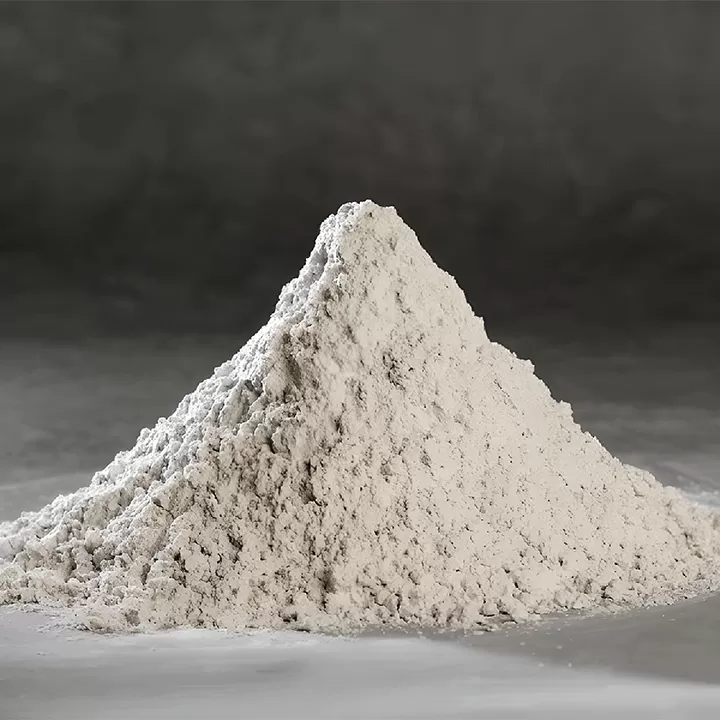
Golden Fortune has been at the forefront of advanced cementitious materials for over two decades, supplying high-performance solutions to the global construction sector. This technical guide examines the critical properties of white and coloured portland cement, providing engineers and specifiers with actionable insights into material selection, colour consistency, and long-term durability.
1. Manufacturing Fundamentals: From Raw Materials to White Clinker
Unlike ordinary grey Portland cement, white cement requires stringent control over iron (Fe₂O₃) and manganese (MnO) content. Raw meal typically consists of high-purity limestone, kaolin clay, and quartz sand, with iron oxide limited to below 0.35% by mass. The fuel used in the kiln is natural gas or low-ash oil to prevent contamination. After sintering at 1450–1500°C, the clinker undergoes rapid water quenching (shock cooling) to preserve the C₃S phase and prevent reduction of chromophores. This yields a whiteness index (ISO 2470-1) exceeding 85% for premium grades. For white and coloured portland cement, this base whiteness is essential because any residual grey tone will distort subsequent pigment additions.
Key Quality Parameters for White Clinker
Fe₂O₃ ≤ 0.35% – Prevents greenish-brown hues
MgO ≤ 2.5% – Avoids brucite expansion in set cement
Loss on Ignition (LOI) ≤ 1.5% – Ensures complete calcination
C₃A content 4–8% – Controls setting time and pigment compatibility
2. Production of Coloured Variants: Pigment Integration and Compatibility
Coloured Portland cement is typically manufactured by blending synthetic inorganic pigments with white cement during intergrinding or post-blending. The most reliable method uses intergrinding in a separate ball mill to achieve homogeneous dispersion without pigment agglomeration. Common pigments include:
Iron oxides (red, yellow, black, brown) – Cost-effective, UV-stable, but sensitive to alkaline hydrolysis in high-pH cement paste.
Chromium oxide (green) – Excellent lightfastness, but higher cost.
Cobalt blue (aluminate-based) – Intense colour, though rare due to cobalt price volatility.
Titanium dioxide (TiO₂) – Used for super-white or pastel shades; also photocatalytic.
Pigment dosage typically ranges from 2% to 10% of cement mass. Exceeding 8% can reduce 28-day compressive strength by up to 15% due to increased water demand and dilution of hydraulic phases. Therefore, professional specifiers always request strength-activity tests (ASTM C109) on pigmented blends before project execution.
3. Technical Parameters for Colour Consistency and Quality Control
Batch-to-batch colour variation is a persistent complaint among precast concrete manufacturers. To mitigate this, producers of white and coloured portland cement must implement digital colourimetry (CIE L*a*b* system) with tolerance of ΔE ≤ 1.5. Additional parameters to monitor:
Fineness (Blaine) – 400–550 m²/kg ensures pigment distribution without excessive water demand.
Setting time (initial) – 90–180 minutes; faster setting can trap air bubbles affecting surface colour.
Alkali content (Na₂Oₑq) – Below 0.6% to reduce efflorescence (white salt deposits that mar coloured surfaces).
Chloride (Cl⁻) – <0.05% to avoid reinforcement corrosion in architectural concrete.
For architectural precast panels, manufacturers also test freeze-thaw resistance (ASTM C666) and accelerated weathering (QUV chamber, 2000 hours) to ensure the pigment-cement matrix does not chalking or fading.
4. Application-Specific Engineering Considerations
Different end-uses demand distinct performance profiles from coloured cement systems. Below are the most demanding applications and their technical requirements:
4.1 Polished Terrazzo & Flooring
Requires high early strength (≥25 MPa at 7 days) to survive grinding and polishing. The cement must have low shrinkage (≤0.06% at 28 days) to prevent hairline cracks that collect dirt and ruin aesthetics. Golden Fortune supplies ultrafine GGBFS that, when used up to 15% in dark-coloured terrazzo, improves abrasion resistance and reduces heat of hydration.
4.2 Glass-Fibre Reinforced Concrete (GRC)
For lightweight facade panels, the cement matrix must have pH below 12.5 to prevent alkali attack on AR-glass fibres. Coloured white cement with metakaolin or silica fume (10–15% replacement) lowers the pore solution pH while enhancing flexural strength. Pre-blended coloured GRC cements are now available from specialized suppliers.
4.3 Dry-Mix Renders & Grouts
Here, water-cement ratio is field-controlled. Pigment separation can occur if the cement lacks proper flow agent compatibility. Adding a polycarboxylate superplasticizer (0.2–0.5% by mass) maintains colour uniformity even at low w/c ratios (0.35–0.40).
5. Industry Pain Points: Causes and Corrective Actions
Even high-quality white and coloured portland cement can result in site failures if handling or application protocols are ignored. The following table summarizes common issues and engineering remedies:
Efflorescence: White calcium carbonate deposits on coloured surfaces. Solution: Use low-alkali cement (Na₂Oₑq <0.6%), add a hydrophobic admixture (stearate or silane), and ensure proper curing to reduce moisture migration.
Colour darkening after rain: Occurs when unreacted pigments leach out. Solution: Specify water-repellent integral admixtures and avoid over-troweling that brings excess water to surface.
Batch-to-batch mismatch: Often due to using different pigment lots or base cement shipments. Solution: Demand a "reference sample" and spectrophotometer certificate for each delivery; blend multiple silos at plant.
Reduced workability: Pigments increase water demand. Solution: Adjust superplasticizer dosage; for high-pigment loads (e.g., 10% black iron oxide), consider using a deflocculant like sodium gluconate.
6. Role of Mineral Additives in Coloured Cement Systems
While ground granulated blast-furnace slag (GGBFS) is typically grey, modern ultrafine GGBFS (specific surface 700–900 m²/kg) can be used in dark-coloured architectural concrete to improve long-term strength and reduce permeability. For example, replacing 20% of white and coloured portland cement with a white slag (produced from special pig iron feed) yields a pastel matrix with lower CO₂ footprint. Golden Fortune offers a range of ultrafine GGBFS products that, when combined with white cement, enhance sulphate resistance and reduce autogenous shrinkage. However, for light or vibrant colours (yellow, light red), any dark supplementary material should be avoided; instead, use limestone filler (CaCO₃ ≥98%) which does not alter colour.
Other common mineral additions:
Metakaolin: Light cream colour; increases whiteness and reduces efflorescence.
Precipitated silica: High purity white powder; boosts early strength for coloured mortars.
Calcium aluminate cement (CAC): Used in rapid-setting coloured floor screeds; note that CAC can react with pigments differently (test required).
7. Quality Standards and Certification for Professional Buyers
When sourcing white and coloured portland cement, always request compliance with the following standards to ensure global acceptance:
ASTM C150 Type I/III – White cement classification (minimum whiteness 85).
EN 197-1 CEM I 52.5 R (White) – European standard with strict chromate and pigment limits.
ISO 10621 – Determination of colour fastness to UV radiation for pigmented cements.
BS 12 – Specific sulphate resistance for white cement used in marine environments.
Leading manufacturers provide third-party test reports including XRF elemental analysis, XRD phase quantification, and 5-year outdoor exposure trials. These documents are essential for any large-scale façade or infrastructure project.
8. Frequently Asked Questions (FAQ) on White and Coloured Portland Cement
Q1: Can I use ordinary grey Portland cement to make coloured concrete by adding pigments?
A1: Technically yes, but the resulting colours will be muddy (grey undertone). True vibrant reds, blues, and yellows require a white base cement. Grey cement contains up to 5% Fe₂O₃ which interacts with pigments, shifting hues toward brown or olive. For architectural specifications, always start with white and coloured portland cement systems designed for colour purity.
Q2: How do I prevent pigment segregation during transport of ready-mix coloured concrete?
A2: Use a viscosity-modifying admixture (VMA) at 0.05–0.2% by cement mass. Also limit mixing drum revolutions to 70–100 after pigment addition. For dry-bagged coloured cement, request a certified homogeneity index (sampling from 10 bags, standard deviation of colour ΔE < 0.8).
Q3: What is the shelf life of pre-blended coloured Portland cement?
A3: When stored in moisture-proof laminated bags at <25°C and <60% RH, coloured cement retains activity for 6 months. After that, check for pigment agglomeration (fines clumping) and loss of flowability. Avoid stockpiling beyond 3 months for precision colour work because moisture can cause pre-hydration and patchy discoloration.
Q4: Can I add GGBFS to a white cement mix for sustainable coloured concrete?
A4: Yes, but only for dark colours (charcoal, dark brown, forest green) or if using a white slag (rare). Conventional grey GGBFS will turn light-coloured cement into a greyish-green tint. For sustainable light-coloured concrete, replace 5–10% of white cement with white metakaolin or limestone fines. Golden Fortune provides technical datasheets to help calculate colour impact of any supplementary material.
Q5: How do I measure and specify colour tolerance for a precast panel contract?
A5: Use a Konica Minolta or similar portable spectrophotometer measuring L*a*b* values. Industry standard tolerance for adjacent panels is ΔE ≤ 2.0. For non-adjacent panels (different building elevations), ΔE ≤ 3.5. Always specify measurement under D65 standard illuminant (simulates daylight). Require the cement supplier to provide a master colour panel for the project.
Q6: Why does my yellow-coloured cement turn slightly green after one year?
A6: This is typically due to UV-induced degradation of organic pigment impurities. Only use inorganic iron oxide yellow (PY42) or bismuth vanadate (PY184) for exterior applications. Also, avoid any cobalt-based drying agents. Request an accelerated QUV test (ASTM G154) report showing ΔE < 1.5 after 2000 hours.
Ready to Source High-Performance White and Coloured Portland Cement?
Selecting the right cement for architectural or industrial projects requires expert technical support and consistent product quality. Golden Fortune offers a full range of white and coloured Portland cement solutions, backed by laboratory validation and just-in-time logistics. For a detailed quotation, colour formulation assistance, or to request samples for pigment compatibility testing, please contact our B2B technical sales team.
Send your inquiry now: Include project volume, target colour reference (Pantone or RAL), and required compressive strength class. Our engineers will respond within 24 hours with a custom solution and compliance documentation.
Click here to submit an inquiry form or email directly to sales@ultrafineggbs.com (replace with actual contact – use website contact). For immediate technical parameters, visit our product specification page.