For concrete specifiers, ready‑mix producers, and green building consultants, finding a reliable eco friendly cement alternative is no longer a niche requirement – it is a necessity driven by carbon regulations, corporate sustainability goals, and client demand. Ordinary portland cement (OPC) production accounts for roughly 8% of global CO₂ emissions, with nearly 0.9 kg of CO₂ released per kilogram of cement. This article provides a component‑level analysis of seven proven eco friendly cement alternative materials: ground granulated blast furnace slag (GGBS), fly ash, silica fume, calcined clay (LC³), limestone calcined clay cement, magnesium‑based cements, and recycled concrete fines. We will examine their chemical reactivity, effects on concrete properties, environmental benefits, and real‑world applications – from mass foundations to marine structures. Drawing on data from Golden Fortune's supply of high‑quality GGBS, we will also address common industry pain points such as slower early strength, carbonation risk, and supply chain consistency.
1. Why the Construction Industry Needs an Eco Friendly Cement Alternative
The demand for eco friendly cement alternative materials arises from three converging pressures:
Regulatory mandates: The EU Carbon Border Adjustment Mechanism (CBAM) and local low‑carbon concrete codes (e.g., LEED v4.1, BREEAM, EN 15804) require declared global warming potential (GWP) for concrete.
Client specifications: Major infrastructure owners (e.g., HS2, California DOT) now mandate maximum embodied carbon limits for concrete mixes.
Material cost volatility: OPC prices have risen due to energy costs and emissions trading; alternative binders often offer cost stability.
An effective eco friendly cement alternative must maintain or improve mechanical properties, durability, and workability while reducing CO₂ by at least 30% compared to OPC. Golden Fortune supplies GGBS (ground granulated blast furnace slag) which, when used as a 30–70% replacement for OPC, cuts CO₂ by 40–60% and enhances sulfate resistance and chloride ingress protection.
2. Ground Granulated Blast Furnace Slag (GGBS): The Most Established Eco Friendly Cement Alternative
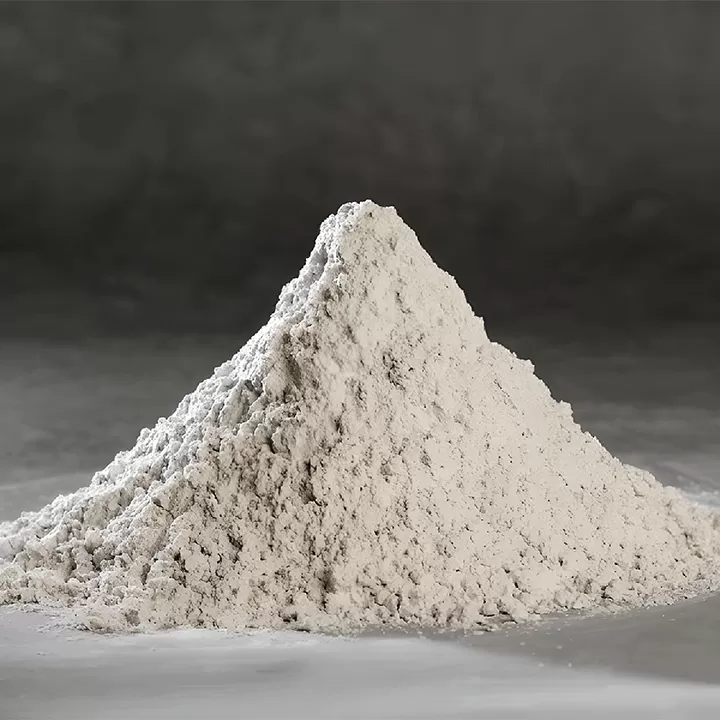
GGBS is a byproduct of iron production – molten slag quenched with water, then ground to a fine powder. It has latent hydraulic properties: it reacts with calcium hydroxide (CH) produced during OPC hydration to form additional calcium silicate hydrate (C‑S‑H). Key characteristics:
Typical replacement level: 30–70% by mass of total binder.
CO₂ reduction: 40–60% compared to OPC (each ton of GGBS saves ~0.8 ton CO₂).
Performance benefits: Lower heat of hydration (ideal for mass concrete), higher ultimate strength (90–120% of OPC at 28 days for 50% slag), improved sulfate and seawater resistance, lighter color.
Challenges: Slower early strength development (requires extended curing or higher temperature), potential for efflorescence if not properly cured.
GGBS meets ASTM C989 (Grades 80, 100, 120) and EN 15167-1. When specifying an eco friendly cement alternative, many engineers choose GGBS because of its consistent chemistry, wide availability, and decades of field data. Golden Fortune’s GGBS is ultrafine (Blaine > 600 m²/kg) for enhanced reactivity.
3. Fly Ash: A Widely Available Supplementary Cementitious Material
Fly ash (pulverised fuel ash) is a byproduct of coal‑fired power plants. It is pozzolanic (reacts with CH to form C‑S‑H). Two classes per ASTM C618:
Class F: Low calcium (<10% CaO) – from anthracite/bituminous coal. High pozzolanic activity, improves sulfate resistance.
Class C: High calcium (>15% CaO) – from lignite/subbituminous coal. Some self‑cementing properties, but higher water demand.
Replacement levels: 15–35% for Class F, 15–40% for Class C. Benefits: improved workability (spherical particles), reduced bleeding, lower heat of hydration. Disadvantages: slower early strength, seasonal variability in chemistry, and concerns about heavy metals (though most fly ash is non‑hazardous). Availability is declining as coal plants retire; thus many are turning to GGBS or calcined clays as a more reliable eco friendly cement alternative.
4. Calcined Clay and Limestone Calcined Clay Cement (LC³)
LC³ is a ternary blend of OPC, calcined clay, and limestone filler. The clay (kaolinite, 40–60%) is heated to 700–850°C to become reactive metakaolin. When combined with limestone, it forms carboaluminate hydrates that refine pore structure.
Typical composition: 50% OPC, 30% calcined clay, 15% limestone, 5% gypsum.
CO₂ reduction: 30–40% compared to OPC.
Performance: Comparable 28‑day strength to OPC, better chloride resistance, and lower heat of hydration.
Availability: Clays are abundant worldwide, making LC³ a locally sourced eco friendly cement alternative.
However, calcination of clay still requires energy, and the process needs careful control to avoid over‑firing. Several commercial LC³ plants operate in Cuba, Switzerland, and India.
5. Silica Fume (Microsilica): High‑Performance Pozzolan
Silica fume is a byproduct of silicon/ferrosilicon production. It consists of amorphous SiO₂ spheres (<1 µm). It is highly pozzolanic but expensive.
Replacement level: 5–15%.
Benefits: Dramatically increases compressive strength (>100 MPa), reduces permeability, improves abrasion resistance.
Disadvantages: High water demand (requires superplasticizers), dark color, and limited supply.
Silica fume is often used in combination with GGBS or fly ash as part of a ternary blend. For most general concrete applications, GGBS remains the more cost‑effective eco friendly cement alternative.
6. Magnesium Oxide‑Based Cements (Novacem, TecEco)
Magnesium oxide (MgO) cements harden by carbonation (absorbing CO₂) or by forming magnesium silicate hydrates (M‑S‑H). They offer potential carbon‑negative footprints. However, commercial adoption is limited due to:
High cost of producing reactive MgO (from magnesite or seawater).
Lower strength compared to OPC (typically 20–40 MPa).
Limited long‑term durability data.
For now, these are niche products for non‑structural applications like blocks and pavers. For structural concrete, GGBS or LC³ remain the preferred eco friendly cement alternative.
7. Recycled Concrete Fines (RCF) as a Supplementary Binder
Recycled concrete aggregate fines (<2 mm) contain hydrated cement paste that can be thermally activated (heated to 500°C) to re‑form reactive phases. This is an emerging eco friendly cement alternative that closes the loop in demolition waste. Current challenges: high energy for activation, variable composition, and limited standardization. Research shows RCF can replace up to 20% of OPC without significant strength loss.
8. Industry Pain Points and Solutions When Using Eco Friendly Cement Alternatives
Even with well‑characterized materials, engineers face recurring issues. Below are three common problems and engineering remedies.
Slow early strength with high GGBS or fly ash: In cold weather (below 10°C), strength gain is delayed. Solution – use a ternary blend (OPC + GGBS + silica fume) or add an accelerating admixture (calcium nitrate). Also increase curing temperature (blankets or steam). For precast, use ultrafine GGBS which has higher early reactivity.
Increased carbonation risk (reduced alkalinity): Lower portlandite (CH) from pozzolanic reactions reduces pH buffering. Solution – ensure adequate cover to reinforcement (increase by 5–10 mm) and use a surface sealer. Alternatively, limit replacement to ≤50% for exposed structures.
Color variation (greenish hue for GGBS, dark gray for fly ash): Architects may reject non‑gray concrete. Solution – use white cement + GGBS blends, or specify a surface coating. For structural concrete, educate clients that color does not affect performance.
Field data from Golden Fortune users show that proper mix design and curing eliminate most performance concerns, yielding concrete with lower life‑cycle cost and carbon footprint.
9. Environmental Metrics: How to Compare Eco Friendly Cement Alternatives
When selecting an eco friendly cement alternative, ask suppliers for Environmental Product Declarations (EPDs) following EN 15804 or ISO 14025. Key indicators per kg of binder:
GWP (global warming potential) – kg CO₂eq: OPC ~900; GGBS ~150; fly ash ~30; calcined clay ~350; silica fume ~40.
Abiotic depletion – mineral resource use.
Water use and energy consumption.
For a C30/37 concrete (30 MPa), replacing 50% of OPC with GGBS reduces GWP from 380 kg CO₂eq/m³ to 220 kg CO₂eq/m³ – a 42% reduction. Using 70% GGBS drops to 160 kg CO₂eq/m³. Many green building credits require at least 30% reduction.
10. Frequently Asked Questions (FAQ) – Eco Friendly Cement Alternatives
Q1: Is GGBS truly an eco friendly cement alternative, or does it have
hidden environmental impacts?
A1: GGBS is a
byproduct of the steel industry – its environmental burden is allocated to the
primary product (pig iron). Thus, using GGBS avoids the CO₂‑intensive clinker
manufacturing step. However, it requires grinding (energy) and transport. Even
accounting for these, GGBS reduces concrete’s carbon footprint by 40–60%
compared to OPC. Golden Fortune’s GGBS is
produced with renewable energy.
Q2: Can I use 100% GGBS as a standalone binder without any portland
cement?
A2: GGBS alone has very slow hydration
(requires alkaline activation). For practical construction, a minimum of 30% OPC
is needed to provide alkalis (pH > 12) to initiate slag reaction. Some
alkali‑activated slags (geopolymers) use sodium silicate or NaOH, but these are
not covered by standard specifications. For most projects, use GGBS as a partial
replacement (30–70%).
Q3: Which eco friendly cement alternative has the lowest carbon
footprint?
A3: Recycled concrete fines (if
thermally activated using waste heat) and magnesium carbonating cements can be
carbon‑negative. However, among commercially available SCMs, fly ash (when
sourced from local plants) has the lowest GWP (~30 kg CO₂eq/ton). But fly ash
quality varies and supply is declining. GGBS offers a good balance of low
carbon, consistent quality, and wide availability.
Q4: Will using an eco friendly cement alternative increase my
concrete cost?
A4: GGBS and fly ash are often
cheaper than OPC per ton (depending on region). However, some alternatives like
silica fume or metakaolin are more expensive. A 50% GGBS mix typically reduces
material cost by 5–10%. The larger economic benefit comes from lower carbon
taxes and eligibility for green building incentives.
Q5: How do I ensure durability when using high volumes of eco
friendly cement alternative?
A5: Follow guidelines
from ACI 233 (slag), ACI 232 (fly ash), or local standards. Key measures:
maintain minimum OPC content (≥ 200 kg/m³), ensure adequate curing (7 days moist
for 50% slag), limit water‑binder ratio (<0.45), and test for carbonation
depth in exposure class XC4. For marine structures, GGBS concrete outperforms
OPC in chloride resistance.
Q6: Can I combine multiple eco friendly cement alternatives in one
mix?
A6: Yes – ternary blends (OPC + GGBS + fly
ash) or quaternary blends (adding silica fume) are common for high‑performance
concrete. They balance early strength, cost, and durability. However, each
material affects workability and water demand; trial batches are necessary.
Golden Fortune provides mix design support for
multi‑binder systems.
11. Partner with a Reliable Supplier of Eco Friendly Cement Alternatives
Choosing the right eco friendly cement alternative requires more than a datasheet – you need consistent quality, technical support, and supply security. Golden Fortune provides high‑grade GGBS (ultrafine, Grade 120) that meets ASTM C989 and EN 15167‑1. Our technical team offers:
Free concrete mix design optimization for your target strength, exposure class, and carbon reduction goal.
Compatibility testing with local aggregates, admixtures, and cements.
Bulk supply with ISO 9001 certification and EPD documentation.
On‑site technical support during trial pours.
Request a free consultation and sample – send us your project requirements, target cement replacement level, and performance criteria. Our engineers will recommend the optimal blend and provide a life‑cycle CO₂ calculation. Click here to contact Golden Fortune’s sustainable binder specialists or call0086-18065065515. We ship globally with short lead times.