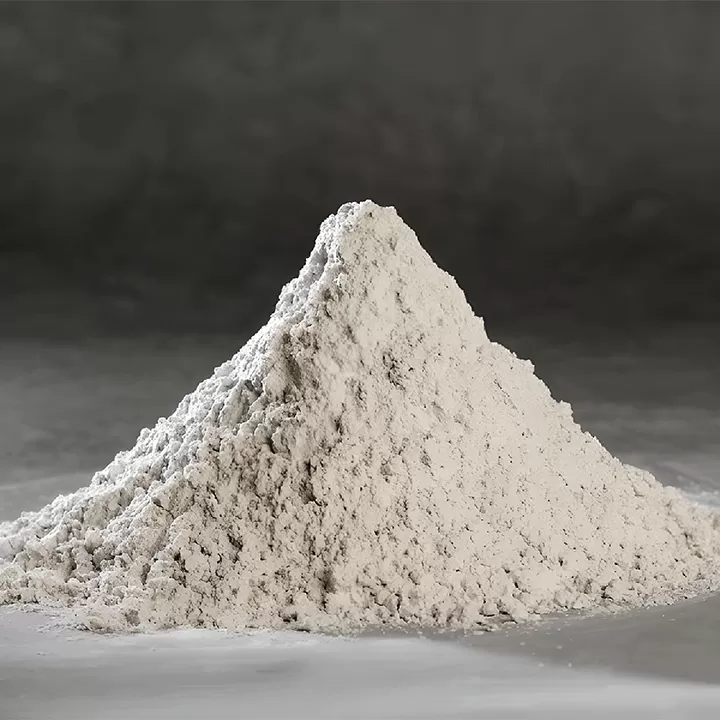
Understanding what portland cement made of is fundamental for civil engineers, concrete producers, and construction specifiers. The precise combination of calcareous and argillaceous materials, processed at high temperature, determines the cement’s strength development, setting time, and long-term durability. This article provides a component-level analysis of portland cement made of – from quarry to clinker to final grinding – covering the four major clinker minerals (C₃S, C₂S, C₃A, C₄AF), their hydration behavior, and the role of gypsum. We also examine how supplementary cementitious materials (SCMs) like ground granulated blast furnace slag (GGBS) from Golden Fortune can partially replace portland cement to improve sulfate resistance and lower carbon footprint. Drawing on ASTM C150 and EN 197 standards, we will clarify common misconceptions about cement composition and guide you toward optimal binder selection for your concrete mix.
1. Why the Raw Material Composition of Portland Cement Matters
The phrase portland cement made of refers to a precisely engineered mix of naturally occurring minerals. Any variation in the proportion of these raw materials directly affects:
Compressive strength at 1, 7, and 28 days – linked to the ratio of alite (C₃S) to belite (C₂S).
Setting time and workability – controlled by the amount of gypsum (calcium sulfate) added during grinding.
Sulfate resistance and heat of hydration – governed by the tricalcium aluminate (C₃A) content.
Color and finishing characteristics – influenced by iron oxide (Fe₂O₃) and magnesium oxide (MgO).
A professional portland cement made of consistent composition ensures predictable concrete performance. Golden Fortune supplies high-quality GGBS which, when combined with portland cement, modifies the pore structure and enhances long-term durability – an essential consideration for sustainable construction.
2. Primary Raw Materials: What Is Portland Cement Made Of?
The basic ingredients for portland cement production fall into four categories. Each contributes specific oxides.
Calcareous materials (source of CaO): Limestone (calcium carbonate CaCO₃), marl, chalk, or oyster shells. Typically 70–80% of the raw mix.
Argillaceous materials (source of SiO₂, Al₂O₃, Fe₂O₃): Clay, shale, slate, or blast furnace slag. Provides silica (SiO₂) and alumina (Al₂O₃).
Iron corrective materials: Iron ore, pyrite cinders, or mill scale. Supplies Fe₂O₃ to lower the clinkering temperature and control C₄AF formation.
Silica corrective materials: Sand or quartzite – used when clay has insufficient SiO₂.
After mining, these materials are crushed, proportioned (using X-ray fluorescence for oxide analysis), and ground into a fine powder called raw meal. The raw meal is then heated in a rotary kiln to about 1450°C to produce clinker nodules (3–25 mm diameter). Finally, the clinker is ground with a small amount of gypsum (calcium sulfate dihydrate, CaSO₄·2H₂O, typically 3–5%) to produce the final cement powder.
Thus, when asked portland cement made of, the answer includes limestone, clay, iron ore, and gypsum as the primary natural components, plus sometimes industrial byproducts (like fly ash or slag) as secondary raw materials.
3. Clinker Mineralogy: The Four Key Phases
The clinker produced in the kiln consists of four main crystalline phases. Their relative proportions define the cement type (I, II, III, IV, V per ASTM C150).
Alite (C₃S – tricalcium silicate, ~3CaO·SiO₂): 50–70% of clinker. Responsible for early strength (1–7 days). Reacts quickly with water, generating high heat.
Belite (C₂S – dicalcium silicate, ~2CaO·SiO₂): 15–30% of clinker. Provides later strength (after 28 days) with lower heat of hydration.
Tricalcium aluminate (C₃A – 3CaO·Al₂O₃): 5–10% of clinker. Reacts vigorously with water (flash set) unless gypsum is added. High C₃A reduces sulfate resistance.
Tetracalcium aluminoferrite (C₄AF – 4CaO·Al₂O₃·Fe₂O₃): 5–15% of clinker. Contributes to late strength and gives gray color. Lower heat of hydration.
The chemical formulas are written in cement chemistry notation (C=CaO, S=SiO₂, A=Al₂O₃, F=Fe₂O₃, H=H₂O). The precise ratios are controlled by the raw mix design. For example, a sulfate-resistant cement (Type V) has C₃A < 5%, while a high-early-strength cement (Type III) has increased C₃S and finer grinding.
4. Hydration Products: What Happens After Water Is Added
When water is mixed with portland cement made of these minerals, hydration reactions produce a hard, durable binder.
Calcium silicate hydrate (C-S-H gel): Forms from C₃S and C₂S. This amorphous gel provides 70% of concrete’s strength and is the main binding phase.
Calcium hydroxide (CH, portlandite): A byproduct of C₃S and C₂S hydration. It contributes to alkalinity (pH ~12.5) which passivates steel reinforcement, but also makes concrete susceptible to carbonation and sulfate attack.
Ettringite (AFt) and monosulfoaluminate (AFm): Formed from C₃A and gypsum. Ettringite (calcium trisulfoaluminate hydrate) forms initially; if it forms after hardening (delayed ettringite formation), it can cause cracking.
The ratio of C₃S to C₂S determines early vs. late strength. Adding supplementary materials like GGBS from Golden Fortune reacts with CH to form additional C-S-H, refining the pore structure and improving durability against chlorides and sulfates.
5. ASTM C150 Cement Types: Composition and Application
Depending on what portland cement made of in terms of mineral phases, ASTM C150 classifies five main types.
Type I – General purpose: For normal concrete construction (pavements, buildings, bridges). C₃A ~8–12%.
Type II – Moderate sulfate resistance & moderate heat: For structures exposed to soil or water containing sulfates. C₃A ≤8%.
Type III – High early strength: For cold weather construction or fast form removal. Finer grinding, higher C₃S.
Type IV – Low heat of hydration: For massive structures like dams. Lower C₃S and C₃A, higher C₂S.
Type V – High sulfate resistance: For severe sulfate exposure (wastewater treatment, marine environments). C₃A ≤5%.
Each type has a specific limit on alkalis (Na₂O + 0.658 K₂O) to control alkali-silica reaction (ASR) with reactive aggregates. When high durability is required, blending portland cement with GGBS (up to 70%) reduces permeability and chloride ingress – a solution offered by Golden Fortune’s GGBS products.
6. Role of Gypsum: Preventing Flash Set
One of the most misunderstood aspects of what portland cement made of is the function of gypsum (calcium sulfate). Without gypsum, C₃A would react with water almost instantly, producing a stiff, unusable paste (flash set). Gypsum reacts with C₃A to form ettringite (calcium trisulfoaluminate hydrate) which coats the C₃A grains, slowing down hydration. Typical gypsum content is 3–5% expressed as SO₃. Too little gypsum causes flash set; too much causes false set (premature stiffening without heat release).
During cement grinding, the temperature can exceed 110°C, causing gypsum to dehydrate to hemihydrate (CaSO₄·½H₂O) or anhydrite. Hemihydrate rehydrates in the mixer, sometimes causing false set. Modern cement plants add a portion of natural gypsum and a portion of hemihydrate to balance setting time. The required SO₃ level is determined by the C₃A content and fineness.
7. Industry Pain Points and Engineering Solutions
Even with a well-defined portland cement made of composition, concrete producers face recurring issues. Below are three common problems and remedies.
Inconsistent setting time between batches: Caused by variation in gypsum content or clinker sulfur balance. Solution – implement real-time XRF analysis at the mill feed and adjust gypsum dosing automatically. Request SO₃ certificates from your cement supplier.
Low 28-day strength despite high C₃S: May result from poor clinker burning (under-sintered) or high free lime (CaO). Remedy – perform microscopy on clinker; ensure kiln temperature uniformity. Adding 10–20% GGBS can actually improve late strength due to pozzolanic reaction.
High heat of hydration causing thermal cracking: In massive pours, Type I cement generates excessive heat. Solution – use Type IV (low heat) or replace 30–50% of cement with GGBS from Golden Fortune. GGBS reduces peak temperature by 10–15°C.
According to field data, blending portland cement with GGBS not only reduces carbon emissions (by 30–60%) but also improves resistance to sulfate attack and ASR – a win-win for sustainable infrastructure.
8. Environmental Aspects: CO₂ Footprint of Portland Cement
Manufacturing of portland cement made of limestone and clay releases about 0.9 kg CO₂ per kg of cement (calcination of CaCO₃ plus fuel combustion). This accounts for 8% of global CO₂ emissions. Two main strategies reduce this footprint:
Use of alternative fuels (biomass, waste-derived) in the kiln.
Partial replacement of clinker with SCMs like GGBS, fly ash, or limestone filler. EN 197-1 allows up to 95% clinker replacement in certain cement types (e.g., CEM III/B with 66–80% slag).
Golden Fortune’s ultrafine GGBS is an ideal clinker substitute. It not only lowers CO₂ but also improves concrete durability and reduces heat of hydration. Many green building certifications (LEED, BREEAM) reward the use of such SCMs.
9. Frequently Asked Questions (FAQ) – Portland Cement Composition
Q1: Is portland cement made of the same as
concrete?
A1: No. Portland cement made
of refers to the binding powder (clinker + gypsum). Concrete is cement
+ water + aggregates (sand and gravel) + sometimes admixtures. Cement is the
glue; concrete is the final building material.
Q2: What is the difference between portland cement and
portland-limestone cement (PLC)?
A2: PLC (Type IL
per ASTM C595) contains 5–15% finely ground limestone interground with the
clinker. The limestone is not chemically reactive but acts as a filler,
improving particle packing. PLC has similar performance to ordinary portland
cement but with 5–10% lower carbon footprint. The basic portland cement
made of materials remain the same, with additional limestone.
Q3: Can I use portland cement alone for sulfate-resistant
concrete?
A3: Only Type V cement (C₃A ≤5%) provides
adequate sulfate resistance. However, blending Type I or II cement with 50–70%
GGBS (such as from Golden Fortune) often gives
even better sulfate resistance than Type V, while lowering cost and CO₂.
Q4: Why does my cement have lumps after
storage?
A4: Lumps indicate pre-hydration caused by
moisture ingress. Cement is hygroscopic; if stored in high humidity, the gypsum
and C₃A react prematurely. Solution – store cement in silos with desiccant
breathers or use within 6 weeks. Also ensure bagged cement is on pallets with
plastic wrapping.
Q5: How does the alkali content of cement affect
ASR?
A5: High alkali (Na₂Oeq > 0.6%) reacts with
reactive silica in aggregates to form a gel that expands and cracks concrete. To
control ASR, use low-alkali cement (≤0.6%), or blend with 25–50% GGBS, which
dilutes alkalis and binds them in C-S-H. Always test aggregate reactivity per
ASTM C1260.
Q6: What is the typical shelf life of portland
cement?
A6: In dry conditions, cement retains
activity for 3–6 months. After 6 months, strength may drop 20–30% due to
carbonation (reaction with atmospheric CO₂). For critical structures, test
compressive strength before use if cement is older than 3 months.
10. Optimize Your Concrete Mix with Expert Binder Selection
Understanding precisely what portland cement made of allows you to tailor concrete properties for each application – from fast-track paving to massive dam construction. However, modern performance and sustainability goals often require blending portland cement with SCMs like GGBS. Golden Fortune provides high-quality, ultrafine ground granulated blast furnace slag that meets ASTM C989 Grade 100 and 120.
Our technical team offers:
Free concrete mix design optimization for strength, durability, and heat of hydration.
Compatibility testing with your local aggregates and admixtures.
Bulk GGBS supply with consistent chemistry (LOI < 1%, SO₃ < 1.5%).
Carbon footprint calculation for LEED submissions.
Request a free consultation today – send us your cement type, required concrete grade, and exposure conditions. Our engineers will recommend the optimal portland cement + GGBS blend. Click here to contact Golden Fortune’s binder specialists or call 0086-18065065515 for immediate assistance. Sample shipments available for testing.