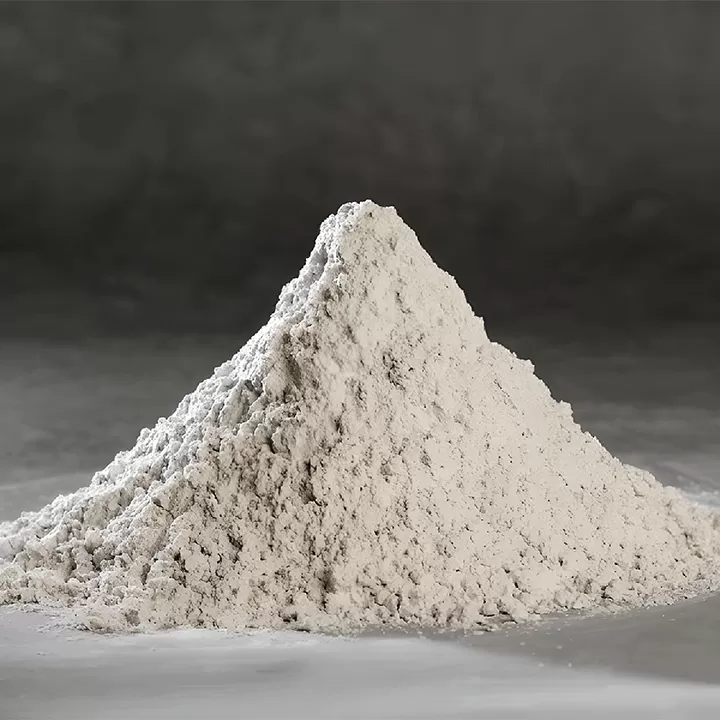
Industrial warehouses, distribution centers, and manufacturing plants rely on concrete on ground slabs that resist cracking, curling, and abrasion from heavy forklift traffic. Yet many projects suffer from premature joint deterioration, plastic shrinkage cracks, or dusting surfaces. This article examines the engineering parameters that determine long-term performance of concrete on ground – from subgrade preparation to mix proportioning using ground granulated blast furnace slag (GGBFS). Golden Fortune supplies high-quality ultrafine GGBFS that modifies the hydration kinetics and pore structure, directly addressing the most common failure modes in ground-supported slabs.
1. Key Failure Mechanisms in Concrete on Ground Slabs
Before selecting a mix design, engineers must understand the physical and chemical stressors unique to concrete on ground. Unlike suspended slabs, ground slabs interact with the subbase, moisture vapor transmission, and point loads from racking systems. The predominant distresses include:
Plastic shrinkage cracking – Rapid moisture loss from fresh concrete surface, typically within 4–8 hours after placement.
Drying shrinkage cracking – Long-term volume reduction due to water evaporation from hardened cement paste.
Curling at joints – Differential moisture or temperature between top and bottom of slab, causing edges to lift.
Abrasion and dusting – Weak surface paste due to high water-cement ratio or improper finishing.
Chemical attack from deicing salts or aggressive soils – Sulfates and chlorides penetrate through microcracks.
Each of these failures can be mitigated by adjusting binder composition. Replacing a portion of ordinary Portland cement (OPC) with granulated blast furnace slag (GGBFS) reduces total heat of hydration, refines pore structure, and improves long-term strength. High-performance mineral additives from Golden Fortune have shown a 30–40% reduction in drying shrinkage compared to plain OPC mixes in ground-supported slabs.
2. Mix Design Optimization for Durable Concrete on Ground
Designing concrete on ground requires balancing workability, early strength for construction traffic, and long-term durability. Below are critical parameters with recommended ranges.
2.1 Binder System: OPC + GGBFS Blends
For industrial ground slabs exposed to heavy dynamic loads (e.g., forklifts up to 8 tons), a ternary binder or binary OPC-slag blend is preferred. GGBFS replacement levels of 30% to 50% by mass provide:
Reduced adiabatic temperature rise – lowers thermal cracking risk in large-pour sections.
Refined capillary porosity – reduces water absorption and chloride ingress.
Improved sulfate resistance – especially beneficial for slabs on sulfate-bearing subgrades.
However, high slag contents (>50%) may slow setting time in cold weather. Use accelerating admixtures or limit replacement to 40% for winter pours. Golden Fortune provides ultrafine GGBFS with Blaine fineness >600 m²/kg, which accelerates early pozzolanic reaction and achieves 28-day strength equivalent to OPC even at 50% replacement.
2.2 Water-to-Binder Ratio and Workability
Maximum w/b ratio for industrial ground slabs should be 0.50, preferably 0.45–0.48. Lower w/b reduces drying shrinkage but may impair finishing. Use high-range water reducers (HRWR) to achieve 120–150 mm slump without excess water. For slabs with heavy abrasion (e.g., forklift aisles), target w/b ≤0.45 and specify a dry-shake hardener topping.
2.3 Aggregate Selection and Gradation
Maximum nominal aggregate size typically 20 mm for slabs 150–200 mm thick. Well-graded crushed stone (60% coarse, 40% fine) reduces paste volume, thereby lowering shrinkage. Avoid flat or elongated particles that increase water demand. For high-tolerance floors (e.g., narrow-aisle warehouses), specify deleterious material content <1% and Los Angeles abrasion loss <30%.
3. Subgrade and Subbase Preparation for Concrete on Ground
Even the best mix design will fail if the supporting layers are inadequate. For concrete on ground, the subbase must provide uniform support to prevent differential settlement. Requirements:
Compacted granular fill – Minimum 150 mm thickness, compacted to 95% of modified Proctor density.
Moisture barrier – 10-mil polyethylene sheeting over subbase to prevent water wicking and reduce curling.
Vapor retarder – For moisture-sensitive floor coverings (epoxy coatings, VNA racking), install a low-permeance vapor barrier (0.1 perms or less).
Concrete placement over vapor retarder – Slip sheet (e.g., 4-mil poly) to reduce friction, which lowers shrinkage restraint stresses.
Field verification: Perform plate load tests or dynamic cone penetrometer (DCP) to confirm subgrade modulus. Minimum modulus of subgrade reaction (k) = 50 pci for ground-supported industrial slabs.
4. Joint Layout and Reinforcement Strategies
Joints in concrete on ground control shrinkage cracking. Poor joint design leads to spalling and differential settlement. Best practices:
Saw-cut contraction joints – Depth at least 1/4 of slab thickness; spacing 24–36 times slab thickness (e.g., for 150 mm slab, joint spacing 3.6–5.4 m).
Load transfer devices – Diamond-plated dowels or square dowels at joints subject to heavy vehicle traffic. Avoid smooth round dowels that lock movement.
Reinforcement – Welded wire fabric (WWF) or steel fibers (30–40 kg/m³) do not prevent shrinkage but hold cracks tight. For crack-free performance, consider shrinkage-compensating cement or post-tensioned slabs.
Steel fiber reinforcement also improves abrasion resistance and impact capacity – particularly valuable in loading dock areas. When using GGBFS-based concrete, the bond between fibers and paste is enhanced due to denser matrix, as documented by Golden Fortune laboratory tests.
5. Placement, Finishing, and Curing Protocols
Field practices directly affect final surface quality. For high-performance concrete on ground, follow these steps:
Pumping and spreading – Avoid adding water at jobsite; use HRWR if slump loss occurs.
Consolidation – Vibrator penetration every 300 mm; do not over-vibrate which causes aggregate segregation.
Screeding and bull-floating – Initial leveling immediately after strike-off.
Power troweling – First pass after bleeding water has evaporated (evaporation rate ≤0.5 kg/m²/h). Two additional passes for hard-troweled finish. For GGBFS mixes, bleeding time may be shorter; monitor surface moisture carefully.
Liquid curing compound – Apply immediately after final troweling (minimum coverage 5 m²/L) or use wet burlap and poly sheeting for 7 days.
Improper curing is the number one cause of surface dusting and plastic shrinkage cracks. For GGBFS-rich mixes, moist curing for at least 7 days is mandatory to activate the pozzolanic reaction; longer curing (14 days) yields higher abrasion resistance.
6. Performance Testing for Concrete on Ground Slabs
Specify the following tests in project quality plan:
Compressive strength (ASTM C39) – Target 35–45 MPa at 28 days for heavy industrial floors.
Flexural strength (ASTM C78) – Minimum 4.5 MPa for unreinforced slabs.
Drying shrinkage (ASTM C157) – Report at 28 days; limit <0.04% for low-shrinkage mixes.
Abrasion resistance (ASTM C944 or C779) – Maximum depth loss 2 mm after 60 cycles for heavy-duty areas.
Surface hardness (Schmidt hammer or pull-off) – For coated floors, minimum 1.5 MPa tensile bond strength.
Using GGBFS blends typically produces 10–20% lower early strength (3 days) but exceeds OPC strength after 56 days. Specify 56-day strength for acceptance when slag content exceeds 30%.
7. Frequently Asked Questions (FAQ) – Concrete on Ground
Q1: What is the maximum recommended joint spacing for concrete on
ground slabs without reinforcement?
A1: For unreinforced slabs with
thickness ≤150 mm, maximum joint spacing is 4.5 m (15 feet). For slabs 200 mm
thick, spacing can extend to 6 m (20 feet). If steel fibers are added (30
kg/m³), spacing may increase by 30%. Shrinkage-reducing admixtures or GGBFS
blends further reduce crack tendency – concrete on ground with 40% slag has shown
joint spacing up to 7.5 m in controlled field studies.
Q2: How does GGBFS affect the setting time and finishing of concrete
on ground?
A2: GGBFS extends initial setting time by 30–90 minutes
at 20°C, which can benefit large pours by reducing cold joints. However,
finishing windows may shift; monitor surface moisture using a penetration test.
Use accelerating admixtures if early troweling is required. Golden
Fortune ultrafine GGBFS has higher reactivity, reducing set
retardation compared to standard slag.
Q3: What subgrade preparation is necessary to prevent curling in
ground-supported slabs?
A3: Curling arises from moisture or
temperature gradient. To minimize: (1) Provide uniform, compacted subbase with
no soft spots; (2) Install a low-friction slip sheet (polyethylene) to reduce
subbase restraint; (3) Maintain consistent concrete temperature during
placement; (4) Apply curing compound immediately after finishing to prevent
top-surface drying. Proper joint depth (≥25% of thickness) allows controlled
movement, reducing edge stress.
Q4: Can concrete on ground with GGBFS be used in freezing-thawing
environments?
A4: Yes, but require air entrainment (5–7% total air
volume). Slag blends have denser paste, which can reduce air void stability.
Increase mixing time and use a high-quality air-entraining admixture. For
deicing salt exposure, keep w/b ≤0.45 and specify slag content 25–35% to improve
chloride resistance. Avoid >50% slag in severe freeze-thaw unless tested for
salt scaling resistance per ASTM C672.
Q5: How to repair spalled joints in existing concrete on ground
floors?
A5: Remove loose concrete to sound substrate (minimum 20 mm
depth). Apply bonding primer, then fill with polymer-modified repair mortar or
shrinkage-compensated grout. For high-traffic areas, use a rapid-hardening
repair mix with added steel fibers. After repair, saw-cut new joint alignment
within 24 hours. Preventive measure: Use load-transfer dowels and proper joint
sealing to prevent water infiltration and freeze-thaw damage.
8. Long-Term Durability and Life-Cycle Cost
Selecting appropriate materials for concrete on ground influences maintenance cycles. A floor with low shrinkage, high abrasion resistance, and chemical resilience will operate for 30+ years with minor joint repairs. Initial cost savings from a cheap mix (high w/b, no slag) often lead to expensive diamond grinding or epoxy overlays within 5–7 years. Life-cycle analysis shows that a 40% GGBFS mix with shrinkage-reducing admixture adds 12–15% to material cost but reduces total ownership cost by 40% over 20 years.
For projects requiring high flatness (Fmin ≥ 100 for narrow-aisle forklifts), specify a separate floor flatness/levelness specification (ASTM E1155) and use laser screed placement. Slag blends do not impair flatness when proper workability is maintained.
To obtain technical datasheets and mix design recommendations for your ground slab project, contact the engineering support team at Golden Fortune. Our laboratory provides customized proportioning based on local aggregates, subgrade conditions, and traffic loads.
Send your project requirements (slab thickness, design traffic, subgrade report) to the Golden Fortune inquiry portal. Receive a preliminary mix design, shrinkage prediction, and joint layout recommendation within 4 business days – including dosage rates for ultrafine GGBFS and HRWR.