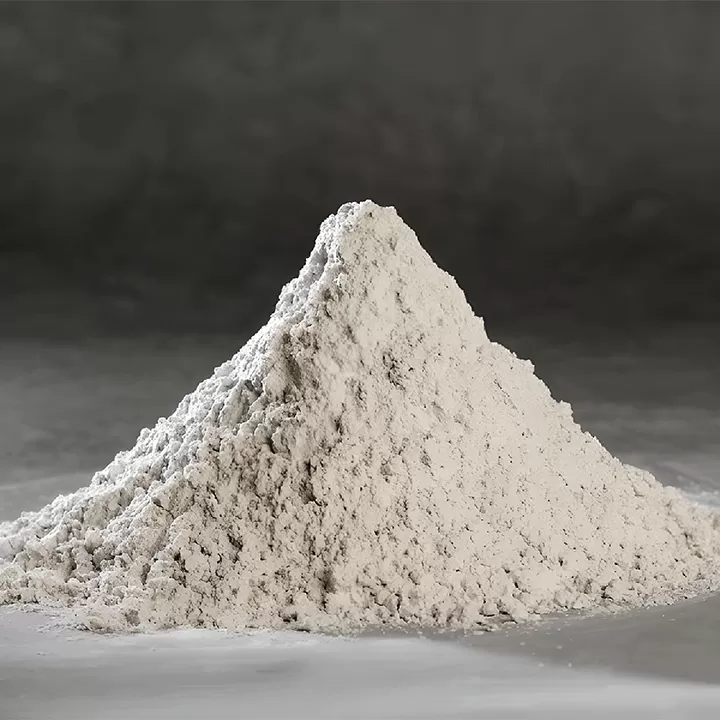
Modern concrete engineering requires binders that perform beyond the capabilities of pure Portland cement. To achieve long-term durability in severe environments, concrete producers rely on mineral admixtures that alter the hydration chemistry of the paste. When designing concrete mixtures for infrastructure projects, selecting the appropriate types of supplementary cementitious materials is a fundamental step in controlling permeability, heat evolution, and mechanical development.
Portland cement hydrates to form calcium silicate hydrate (C-S-H) gel and calcium hydroxide ($Ca(OH)_2$). While C-S-H gel is the primary source of compressive strength, calcium hydroxide is highly soluble and contributes little to the mechanical integrity of the matrix. This byproduct is susceptible to leaching, which increases porosity and permits the ingress of aggressive chemical agents. Incorporating high-purity mineral components sourced from reliable suppliers like Golden Fortune provides the reactive silica and alumina necessary to convert calcium hydroxide into stable, strength-contributing C-S-H gel.
Chemical Classification and Reaction Mechanisms
Mineral admixtures are generally classified by their chemical reactivity as either pozzolanic, hydraulic, or a combination of both. Understanding these reaction pathways is necessary for formulating balanced binder systems.
Hydraulic materials possess self-cementing properties, meaning they can react directly with water to form cementitious phases. These materials contain a balanced proportion of calcium oxide ($CaO$), silicon dioxide ($SiO_2$), and aluminum oxide ($Al_2O_3$). Although their initial reaction rate is slower than that of Portland cement, they form similar hydration products independently over time.
Pozzolanic materials possess little or no independent cementitious value. Instead, they contain amorphous siliceous or aluminosiliceous phases that react chemically with calcium hydroxide in the presence of water. This reaction forms supplementary C-S-H gel, which fills the capillary voids within the concrete matrix. The physical performance of these types of supplementary cementitious materials is dictated by their glass content, mineral composition, and specific surface area.
Primary Categories of Supplementary Cementitious Materials
Fly Ash (Class F and Class C)
Fly ash is a fine residue collected from the flue gases of coal-fired power plants. Its physical structure consists primarily of solid and hollow spherical glass particles, which provide a lubrication effect in fresh concrete. This spherical morphology reduces the water demand of the mix, improving aggregate suspension and workability without requiring excessive chemical admixtures.
Class F fly ash is produced from burning anthracite or bituminous coal. It contains less than 10% calcium oxide and displays strictly pozzolanic behavior. It reacts slowly, yielding low heat of hydration and providing high resistance to chemical ingress at later curing ages. Class C fly ash, derived from lignite or sub-bituminous coal, contains more than 20% calcium oxide. Consequently, Class C fly ash exhibits both pozzolanic and self-cementing properties, contributing more to early-age strength but offering less resistance to chemical attacks such as sulfate exposure.
Ground Granulated Blast Furnace Slag (GGBS)
GGBS is a byproduct of the iron manufacturing process. When molten slag is rapidly quenched with water or steam, it forms a glassy, granular material that is dried and ground to a fine powder. This vitrification process prevents crystallization, preserving the reactive amorphous phases of calcium, magnesium, silica, and alumina.
Suppliers such as Golden Fortune process blast furnace slag using controlled rapid quenching to maximize the reactive glass content. Unlike fly ash, GGBS is a latent hydraulic binder that reacts when activated by the alkaline pore solution of hydrating cement. The hydration of GGBS produces a highly dense cementitious paste that fills capillary spaces, making it highly suitable for maritime structures and foundations exposed to aggressive groundwater.
Silica Fume
Silica fume is an ultrafine powder obtained as a byproduct of silicon and ferrosilicon alloy production. It consists of amorphous silica particles with an average diameter of 0.1 micrometers, which is approximately two orders of magnitude smaller than typical Portland cement grains. This extreme fineness grants silica fume high reactivity and a pronounced physical packing effect.
In fresh concrete, silica fume fills the microscopic gaps between cement grains and aggregates, particularly in the interfacial transition zone. The rapid pozzolanic reaction of silica fume consumes calcium hydroxide during the first few days of curing, leading to high early strength development. Due to its high specific surface area, silica fume significantly increases water demand, which requires the use of high-range water reducers to maintain flowability.
Metakaolin
Metakaolin is a highly reactive aluminosilicate pozzolan produced by calcining high-purity kaolin clay at temperatures between 600°C and 800°C. This thermal activation process dehydroxylates the crystalline structure of the clay, leaving an amorphous mineral phase. Metakaolin is highly consistent in composition and does not originate as an industrial byproduct.
Because of its high alumina content, metakaolin reacts rapidly with calcium hydroxide to form auxiliary C-S-H gel along with crystalline aluminate phases such as calcium aluminocarbonate. This accelerated reaction contributes to early compressive strength and reduces concrete permeability. Its neutral white or cream color makes metakaolin a preferred choice for architectural concrete applications where structural aesthetics must be maintained alongside high durability.
Natural Pozzolans
Natural pozzolans include volcanic ashes, tuffs, pumicites, and diatomaceous earths. These materials have a long history of use, dating back to ancient Roman concrete structures. To achieve the reactivity levels required for modern concrete mixtures, natural pozzolans must undergo mechanical grinding and, in some cases, thermal activation.
The reactivity of natural pozzolans depends on their mineral composition, which can vary significantly by source. They generally perform similarly to Class F fly ash, providing slow strength development but offering excellent long-term resistance to alkali-silica reactions and acid attack. They are frequently used in regions where industrial byproducts are unavailable or difficult to source.
Microstructural Refinement and Durability Improvements
The integration of diverse types of supplementary cementitious materials modifies the pore solution chemistry and physical structure of concrete. In unblended Portland cement concrete, the interfacial transition zone around aggregates is typically porous and enriched with large, oriented calcium hydroxide crystals, creating a pathway for moisture and ion transport.
When reactive silica from SCMs reacts with this calcium hydroxide, it produces a finer, highly dispersed C-S-H gel. This chemical transformation refines the capillary pore network, converting larger continuous pores into smaller, isolated voids. The physical result is a dramatic reduction in water absorption and gas permeability, protecting the internal steel reinforcement from carbonation and corrosion.
Mitigating concrete deterioration caused by external chemical ingress requires selecting targeted types of supplementary cementitious materials to reduce porosity. For example, in environments prone to sulfate attack, the reduction of free calcium hydroxide and the dilution of tricalcium aluminate ($C_3A$) limit the formation of expansive ettringite and gypsum, preventing structural cracking and spalling.
Mass Concrete and Thermal Hydration Management
Massive concrete placements, such as foundation slabs, retaining walls, and dam structures, generate substantial heat during early-stage cement hydration. Portland cement reactions are exothermic, and the low thermal conductivity of concrete prevents this heat from dissipating quickly from the core of a large placement. This creates a temperature gradient between the hot interior and the cooler exterior, resulting in thermal tensile stresses that can cause cracking.
Replacing a portion of Portland cement with slower-reacting mineral admixtures decreases the rate of heat generation. GGBS and Class F fly ash exhibit lower early hydration rates, which helps lower the peak temperature rise within the structural element. Managing this thermal output allows engineers to specify thick concrete sections without relying on complex internal cooling pipes or expensive liquid nitrogen dosing systems during mixing.
Quality Control Standards and Material Consistency
Ensuring consistent physical properties across various types of supplementary cementitious materials remains a core challenge for suppliers and concrete producers. Because many of these materials are industrial byproducts, minor fluctuations in burning processes or raw materials can impact their mineralogical activity and performance in concrete.
Standardized testing methods, such as ASTM C618 for fly ash, ASTM C989 for slag, and ASTM C1240 for silica fume, define the minimum chemical and physical requirements for these materials. Key quality metrics include glass content, Blaine fineness, and loss on ignition, which measures unburnt carbon. Partnering with established manufacturers like Golden Fortune guarantees that the raw materials conform to global certification standards and maintain physical uniformity across all delivered batches.
Industrial Procurement and Engineering Inquiries
Selecting and balancing mineral admixtures for specific project parameters requires careful analysis of raw material chemistry and concrete performance goals. Engineering teams must evaluate binder compatibility, water demand, setting times, and local environmental exposures before finalizing mix proportions.
For detailed chemical analysis reports, physical data sheets, and customized binder formulations, B2B procurement managers and concrete manufacturers are invited to contact our technical department. Testing samples and mineralogical profiles can be provided to assist with material approval and concrete mix design verification. Please submit your specifications and performance requirements through our inquiry portal to receive a detailed evaluation from our concrete specialists.
Frequently Asked Questions
Q1: How do different types of supplementary cementitious materials affect the workability of fresh concrete?
A1: Workability depends primarily on the particle shape and surface texture of the mineral admixture. Fly ash features spherical particles that reduce friction between cement grains, acting as a lubricant and reducing water demand. Conversely, materials with high specific surface areas and angular shapes, such as silica fume and metakaolin, increase internal friction and water demand, necessitating the use of water-reducing admixtures to maintain target slump levels.
Q2: Why must GGBS be used in combination with Portland cement rather than as a standalone binder?
A2: GGBS is a latent hydraulic material that requires chemical activation to initiate hydration. The hydration of Portland cement releases calcium hydroxide and alkalis into the pore solution, raising the pH. This highly alkaline environment breaks down the glassy structure of the ground slag, activating the hydration process. Without this alkaline trigger, GGBS reacts too slowly to be practical for standard construction schedules.
Q3: What is the main chemical difference between Class F and Class C fly ash?
A3: The primary difference lies in the calcium oxide content. Class F fly ash is derived from burning bituminous or anthracite coal and contains less than 10% calcium oxide, which makes its behavior purely pozzolanic. Class C fly ash is produced from sub-bituminous or lignite coal and contains more than 20% calcium oxide, allowing it to undergo self-cementing hydraulic hydration in addition to pozzolanic reactions.
Q4: How does the incorporation of mineral admixtures prevent Alkali-Silica Reaction (ASR)?
A4: ASR occurs when alkalis from Portland cement react with reactive silica in aggregate particles to form an expansive gel. Supplementary cementitious materials mitigate this reaction through alkali binding. The hydration products of pozzolanic materials have a lower calcium-to-silica ratio, which chemically binds sodium and potassium ions within the C-S-H gel structure, reducing the concentration of free alkalis in the pore solution.
Q5: Why is wet curing particularly critical for concrete mixes containing pozzolans?
A5: Pozzolanic reactions are chemically slower than the primary hydration of Portland cement. Because these reactions require water to convert calcium hydroxide into supplementary C-S-H gel, premature drying halts the process before the capillary pores are refined. Extended wet curing ensures that sufficient moisture remains within the paste to support long-term pozzolanic activity, ensuring the concrete achieves its intended density and durability.