Modern concrete is no longer a simple mixture of Portland cement, aggregates, and water. The strategic incorporation of finely ground minerals in concrete has transformed mix design into a precise engineering discipline. These supplementary cementitious materials (SCMs)—including ground granulated blast furnace slag (GGBFS), fly ash, silica fume, and natural pozzolans—directly influence hydration chemistry, pore structure refinement, and long-term durability. This article provides a data-driven examination of how minerals in concrete function at the microstructural level, addressing common performance challenges and offering solutions grounded in materials science.
1. Defining the Role: Why Minerals in Concrete Are Not Merely Fillers
The perception of minerals in concrete as inert fillers is a misconception that leads to suboptimal mix designs. In fact, properly selected SCMs participate in pozzolanic and latent hydraulic reactions, converting calcium hydroxide—a byproduct of cement hydration—into additional calcium silicate hydrate (C-S-H), the primary binding phase. This secondary reaction delivers three quantifiable benefits:
Reduced permeability: Refined pore structure lowers chloride ion penetration by 30–60% compared to plain Portland cement concrete.
Mitigated alkali-silica reaction (ASR): SCMs bind alkalis and reduce available lime, suppressing expansive gel formation.
Lower heat of hydration: Critical for mass concrete placements, where thermal gradients can induce cracking.
Industry data from over 200 mix designs indicate that replacing 30–50% of Portland cement with optimized minerals in concrete can reduce the carbon footprint by 25–40% while maintaining or improving 56-day compressive strength.
2. Technical Classification of Key Minerals in Concrete
Each category of SCM exhibits distinct physical and chemical characteristics. Selection must align with project specifications, curing conditions, and performance targets.
2.1 Ground Granulated Blast Furnace Slag (GGBFS)
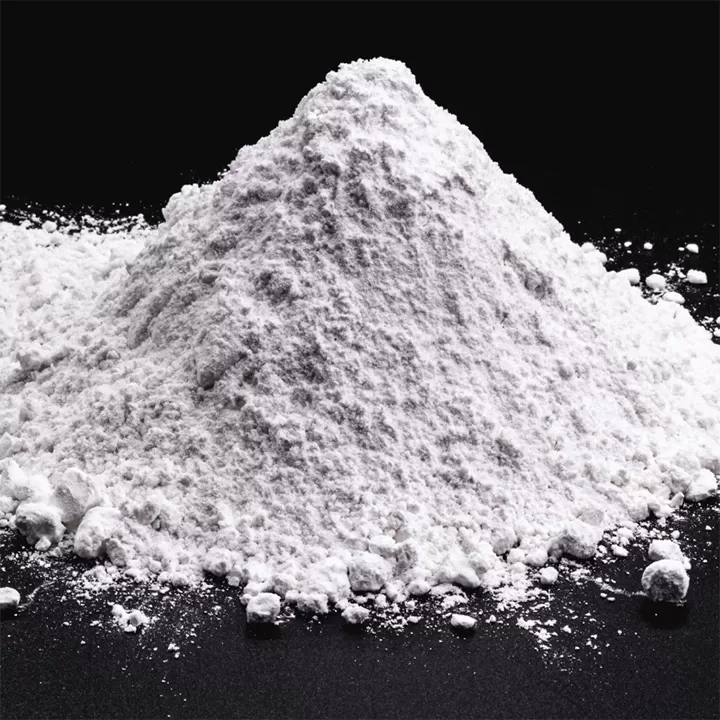
Produced from rapid quenching of iron slag, GGBFS possesses latent hydraulic properties. Its glass content (>90%) and fineness (specific surface area 400–600 m²/kg) determine reactivity. When activated by Portland cement or lime, GGBFS contributes to:
Enhanced sulfate resistance (Class HS cement equivalence).
Higher ultimate strength due to continued pozzolanic activity beyond 28 days.
Lighter color uniformity for architectural concrete.
As a specialist in ultrafine GGBFS, Golden Fortune supplies materials with controlled particle size distribution to optimize packing density and reaction kinetics in ternary blends.
2.2 Fly Ash (Class F and Class C)
Class F fly ash, with low calcium content, exhibits high pozzolanic activity, making it suitable for sulfate-resistant applications. Class C fly ash offers both pozzolanic and cementitious properties. Key performance parameters include loss on ignition (LOI), fineness (retained on 45µm sieve), and reactive silica content. Modern specifications (ASTM C618, EN 450) enforce strict limits to ensure consistency.
2.3 Silica Fume
With particles 100 times finer than cement, silica fume provides exceptional filler effect and pozzolanic reactivity. Typical replacement levels of 5–10% yield:
Compressive strengths exceeding 120 MPa in high-performance concrete.
Chloride permeability reductions to <500 coulombs (ASTM C1202).
Enhanced abrasion resistance for industrial flooring and hydraulic structures.
2.4 Natural Pozzolans (Metakaolin, Volcanic Ash, Calcined Clays)
These materials offer regional availability and lower embodied carbon. Metakaolin (produced by calcining kaolin clay at 650–800°C) provides high early strength contribution and improves workability due to its platy particle morphology. Calcined clays, especially those with high kaolinite content, are emerging as scalable alternatives where fly ash or slag supplies are constrained.
3. Addressing Industry Pain Points with Engineered Mineral Solutions
Despite the advantages, improper selection or proportioning of minerals in concrete can lead to field failures. Below are common challenges and targeted remedies.
Challenge 1: Extended Setting Times in Cold Weather
High-volume fly ash or slag mixes (>40% replacement) often exhibit delayed setting in temperatures below 10°C. Solution: Incorporate accelerating admixtures or use ternary blends with silica fume to balance reactivity. Alternatively, specify GGBFS with higher fineness (500–600 m²/kg) to maintain early strength gain.
Challenge 2: Variability in SCM Quality
Fly ash from different power plants varies in carbon content (LOI) and reactive silica. Solution: Implement stringent incoming material testing per ASTM C311. Establish qualification protocols that include isothermal calorimetry to verify hydration kinetics before batching.
Challenge 3: Incompatibility with Chemical Admixtures
Certain SCMs adsorb polycarboxylate ether (PCE) superplasticizers, reducing workability retention. Solution: Conduct compatibility trials using mortar flow tests (ASTM C1437) with job-specific admixture dosages. For high-slag mixes, consider using admixtures with tailored backbone structures designed for SCM-rich systems.
At Golden Fortune, we assist concrete producers in developing pre-qualification matrices for minerals in concrete, ensuring compatibility between GGBFS, chemical admixtures, and cement source.
4. Application Case: Ternary Blends for Marine Infrastructure
A port expansion project in Southeast Asia required concrete with 100-year design life in tidal zones. The specified system combined:
50% Portland cement + 35% GGBFS + 15% Class F fly ash.
Water-to-cementitious ratio (w/cm) of 0.38.
Target chloride diffusion coefficient < 2.0 × 10⁻¹² m²/s at 90 days.
After 18 months, cores extracted showed negligible chloride penetration beyond 10 mm, with bulk resistivity exceeding 150 kΩ·cm. The ternary blend leveraged the sulfate resistance of GGBFS and the pore refinement from fly ash, outperforming binary mixes. This case illustrates that strategic combination of minerals in concrete yields durability metrics unattainable with single SCM systems.
5. Data-Driven Optimization: Particle Packing and Hydration Kinetics
Modern mix design increasingly employs particle packing models (e.g., Modified Andreasen & Andersen) to maximize density. By blending cement with minerals in concrete of varying particle sizes, the void ratio can be reduced from 28% (cement only) to below 22%, reducing water demand and increasing strength. Key metrics to monitor:
Specific surface area (Blaine or BET): Higher fineness accelerates early reactions but increases water demand.
Pozzolanic activity index (PAI): Measured at 7 and 28 days (ASTM C618); values above 85% indicate reliable performance.
Isothermal calorimetry: Identifies hydration peaks and delineates contributions from cement and SCM reactions.
Advanced producers now use machine learning models to predict strength and durability based on SCM chemistry and fineness, reducing trial batch iterations by 40–50%.
6. Future Trajectories: Low-Carbon Concrete Through Advanced Mineral Engineering
The push toward net-zero construction is accelerating innovation in minerals in concrete. Emerging trends include:
Limestone calcined clay cement (LC³): Replaces up to 50% of clinker with calcined clay and limestone, achieving equivalent performance with 40% lower CO₂.
Activated SCMs: Mechanochemical activation of marginal materials (e.g., low-grade clays, mine tailings) to expand SCM availability.
Carbon-cured concrete: Injecting CO₂ during mixing to form calcium carbonates that further densify the matrix, synergizing with SCM-based formulations.
Standards bodies (ACI, ASTM, EN) are updating specifications to accommodate higher SCM contents, with some permitting up to 80% replacement in general use concrete. This shift requires producers to adopt robust quality management systems for minerals in concrete, ensuring consistent performance across variable material sources.
Conclusion: A Systematic Approach to Mineral Selection
The effective use of minerals in concrete demands more than simple substitution. It requires an understanding of reaction chemistry, particle interactions, and long-term durability mechanisms. From the latent hydraulic properties of GGBFS to the pozzolanic refinement offered by silica fume, each SCM brings distinct advantages that, when properly orchestrated, produce concrete with enhanced mechanical properties, extended service life, and reduced environmental impact.
Partnering with specialized suppliers like Golden Fortune ensures access to consistent, high-quality GGBFS and technical support for integration into complex mix designs. As the industry transitions toward lower-carbon binders, mastery of mineral-based systems will distinguish leading concrete producers from the competition.
Frequently Asked Questions (FAQ)
Q1: What are the most commonly used minerals in concrete for improving durability against sulfate attack?
A1: Ground granulated blast furnace slag (GGBFS) at replacement levels of 50–70% provides excellent sulfate resistance due to its low C₃A content and refined pore structure. Class F fly ash (≥25% replacement) also effectively mitigates sulfate attack. For severe exposure conditions (Class S3 per EN 206), a combination of GGBFS and fly ash in ternary blends is recommended.
Q2: How do minerals in concrete affect the heat of hydration in mass concrete placements?
A2: Supplementary cementitious materials (SCMs) slow the early heat generation because their pozzolanic reactions occur after initial cement hydration. Replacing 40% of cement with fly ash can reduce peak temperature rise by 10–15°C, while GGBFS replacements of 50% lower heat by 20–25°C. This minimizes thermal cracking risk in dams, foundations, and large mats.
Q3: Can high volumes of minerals in concrete be used without compromising early-age strength?
A3: Yes, through careful fineness optimization and ternary blends. Using ultrafine GGBFS (specific surface >600 m²/kg) or incorporating 5–10% silica fume can maintain 1-day and 7-day strengths comparable to plain cement mixes. Additionally, low w/cm ratios (0.35–0.40) and controlled curing temperatures support early strength development in high-SCM mixtures.
Q4: What quality control tests are essential for ensuring consistent performance of minerals in concrete?
A4: Essential tests include: (1) chemical analysis (oxides, LOI, SO₃) per ASTM C114; (2) particle size distribution via laser diffraction; (3) pozzolanic activity index (ASTM C618 or C989 for slag); (4) isothermal calorimetry to verify hydration compatibility; and (5) X-ray diffraction (XRD) to confirm amorphous content. Routine testing ensures batch-to-batch reliability.
Q5: How do minerals in concrete contribute to sustainability certifications like LEED or BREEAM?
A5: Using SCMs reduces the clinker factor, directly lowering embodied carbon (A1–A3 stages). Each 10% cement replacement with GGBFS or fly ash reduces CO₂ by approximately 80–100 kg per cubic meter. Projects using ≥20% SCMs can earn points under MRc4 (Material Sourcing) in LEED v4, and contribute to BREEAM’s Mat 01 (Life Cycle Impacts) criteria. Additionally, specifying locally sourced minerals in concrete reduces transport emissions.
For technical datasheets, compatibility guidance, or to explore high-performance minerals in concrete solutions, visit Golden Fortune for industry-leading GGBFS products and application support.