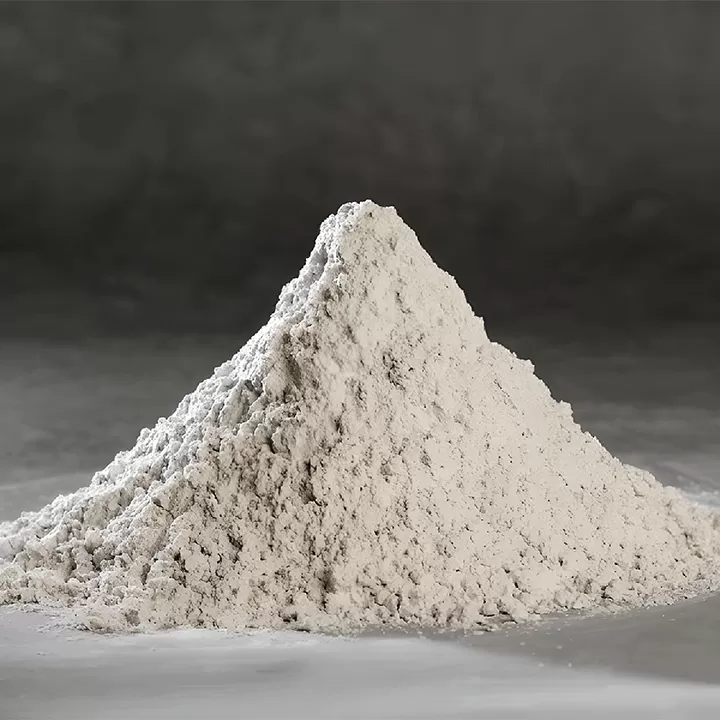
Modern concrete engineering relies heavily on supplementary cementitious materials to enhance the physical properties of concrete while reducing reliance on pure Portland clinker. Among these materials, pulverized fuel ash, commonly known as fly ash, has become a standard component in modern formulations. The use of fly ash in cement production has evolved from a simple disposal solution into a precise science that alters the hydration chemistry of concrete. Industrial suppliers such as Golden Fortune provide high-grade mineral admixtures that meet stringent performance standards, helping cement manufacturers meet precise specifications.
The Chemical Mechanism of Pozzolanic Reactions
To understand the influence of fly ash on cement, one must analyze the hydration process. When Portland cement mixes with water, the primary hydraulic compounds—tricalcium silicate and dicalcium silicate—hydrate to form calcium silicate hydrate gel and calcium hydroxide. While the gel provides structural strength, calcium hydroxide is a soluble crystalline byproduct that does not contribute to strength and can leach out, leaving void pathways that compromise structural integrity.
Fly ash, consisting of siliceous or aluminosiliceous materials, introduces active silica and alumina into the system. These components react with the calcium hydroxide byproduct in the presence of water to form additional calcium silicate hydrate gel. This secondary reaction is known as the pozzolanic reaction. It transforms a structurally weak compound into a stable, strength-contributing phase, densifying the cement matrix over time.
The chemical composition of fly ash varies depending on the coal source, leading to classification under standards like ASTM C618:
- Class F Fly Ash: Derived from anthracite or bituminous coal, containing less than 10% calcium oxide. This class is highly pozzolanic and requires external calcium hydroxide to react.
- Class C Fly Ash: Sourced from lignite or sub-bituminous coal, containing more than 20% calcium oxide. Due to its chemical makeup, Class C fly ash possesses self-cementing properties, meaning it can hydrate and harden independently of Portland cement.
Workability and Particle Packing Physics
Beyond chemical reactivity, physical characteristics significantly alter fresh concrete performance. Evaluating the use of fly ash in cement production requires analyzing how these physical changes affect initial mix characteristics.
The spherical morphology of fly ash particles plays a central role. Unlike the angular, irregular shapes of crushed clinker particles, fly ash particles act as microscopic ball bearings. This spherical structure reduces friction between solid components in the fresh mix, reducing the water demand required to achieve a specific slump. Consequently, engineers can design concrete mixes with lower water-to-cementitious-material ratios, which directly correlates with higher ultimate compressive strengths.
Another physical benefit is particle packing. Incorporating fly ash with varied particle sizes helps fill the interstitial spaces between larger cement grains. This mechanical packing reduces the overall porosity of the unhardened paste, leading to a more cohesive mix with reduced bleeding and segregation tendencies during transport and placement.
Resistance to Chemical Degradation and Environmental Attacks
The primary cause of concrete deterioration in infrastructure is chemical ingress from the environment. Sulfates, chlorides, and reactive alkalis can attack the concrete matrix, causing expansion, cracking, and reinforcement corrosion. Implementing the use of fly ash in cement production effectively shields structures from aggressive soil and marine environments.
Sulfate attack occurs when sulfate ions from groundwater react with calcium hydroxide and tricalcium aluminate hydrates in the cement paste, forming expansive minerals like ettringite and gypsum. Because the pozzolanic reaction consumes calcium hydroxide and dilutes the overall tricalcium aluminate content, the risk of expansive sulfate reactions is significantly reduced.
Chloride-induced corrosion of steel reinforcement is another structural concern. The secondary calcium silicate hydrate gel produced by fly ash refines the pore structure, segmenting continuous capillary channels into isolated, discontinuous pores. This reduced permeability slows the diffusion rate of chloride ions from seawater or deicing salts, extending the operational life of the structure.
Alkali-Silica Reaction is a chemical process where alkalis in the cement pore solution react with active silica in specific aggregates to form an expansive gel. Class F fly ash reduces this risk by binding alkalis within the newly formed hydration products, making them unavailable for reaction with aggregates.
Thermal Stress Mitigation in Mass Concrete Operations
The hydration of Portland cement is an exothermic reaction. In mass concrete structures, such as dam foundations, bridge piers, and thick raft slabs, the heat generated during the initial curing phase cannot dissipate rapidly. This trapped heat leads to steep temperature gradients between the warm core and the cooler exterior, causing thermal stresses that produce micro-cracking.
Replacing a portion of Portland cement with fly ash slows the early rate of hydration and lowers the total heat generation. This slower heat release allows for uniform temperature dissipation, lowering the risk of thermal cracking. As an established provider of cementitious materials, Golden Fortune supplies consistently graded mineral components to manage thermal profiles in large-scale infrastructure projects.
Industrial Standards, Sourcing, and Sieve Residue Control
Industrial applications require consistent raw materials to maintain predictable concrete performance. Standardizing the use of fly ash in cement production involves strict compliance with international standards such as ASTM C618 or EN 450.
Key parameters for quality control include:
- Fineness (Sieve Residue): Typically measured by the retention on a 45-micron sieve. Finer particles offer higher surface area, accelerating the pozzolanic reaction.
- Loss on Ignition (LOI): Measures the residual unburnt carbon in the ash. High carbon content can absorb air-entraining admixtures, compromising freeze-thaw durability.
- Chemical Uniformity: Consistent silica, alumina, and iron oxide content is needed to ensure predictable setting times and strength development.
Sourcing from reliable suppliers ensures that these parameters remain within narrow tolerances, preventing fluctuations during concrete production.
Frequently Asked Questions
Q1: What is the primary difference between Class F and Class C fly ash in cement formulations?
A1: Class F fly ash is produced from burning anthracite or bituminous coal, containing less than 10% calcium oxide (CaO). It requires calcium hydroxide produced during cement hydration to react. Class C fly ash, derived from lignite or sub-bituminous coal, contains more than 20% CaO and possesses self-cementing properties, meaning it can react directly with water without relying solely on the calcium hydroxide byproduct.
Q2: How does the addition of fly ash affect the setting time of concrete?
A2: Substituting Portland cement with fly ash typically extends both the initial and final setting times of concrete. This delay occurs because the pozzolanic reaction progresses slower than the hydration of pure Portland cement. While this characteristic is advantageous in hot weather conditions to prevent premature stiffening, it requires careful monitoring in cold weather climates.
Q3: What role does fly ash play in preventing Alkali-Silica Reaction (ASR)?
A3: Fly ash mitigates ASR by consuming calcium hydroxide and binding alkali ions within the hydration products (C-S-H gel). This reduction in concrete pore solution alkalinity and permeability prevents the formation of the expansive alkali-silica gel that causes cracking in concrete containing reactive aggregates.
Q4: How does Loss on Ignition (LOI) impact concrete performance?
A4: Loss on Ignition indicates the quantity of unburnt carbon remaining in the fly ash. High carbon content can absorb chemical admixtures, particularly air-entraining agents, making it difficult to control the concrete's air content and potentially lowering freeze-thaw durability.
Q5: Can fly ash completely replace Portland cement in structural applications?
A5: No, fly ash cannot completely replace Portland cement in standard structural concrete because it relies on the calcium hydroxide byproduct of cement hydration to activate its pozzolanic properties. Standard substitution rates range from 15% to 35% by weight, depending on the application and environmental exposure conditions.
Industrial Supply and Technical Inquiries
Acquiring mineral admixtures that meet precise chemical and physical standards is vital for consistent concrete performance. Industrial cement producers and readymix companies require reliable suppliers to maintain batch consistency. Contact the technical sales department at Golden Fortune to request product datasheets, bulk shipping schedules, or custom formulation support for your projects.